


Page 84 - Traffic Infra Tech
P. 84
ITS


                                                                 implement updated signal phasing plans. The program considers
                                                                 the network simultaneously, and can therefore integrate traffic
                                                                 signal controllers at individual intersections to coordinate green
                                                                 waves along a network, as well as reduce the overall delay of the
                                                                 network. The model based network control optimizes the signal
                                                                 programs every five minutes in response to current traffic flows.
                                                                 Case study
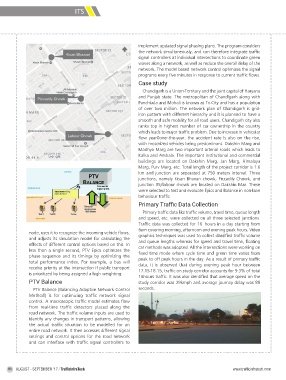
                                                                   Chandigarh is a Union-Territory and the joint capital of Haryana
                                                                 and Punjab state. The metropolitan of Chandigarh along with
                                                                 Panchkula and Mohali is known as Tri-City and has a population
                                                                 of over two million. The network plan of Chandigarh is grid-
                                                                 iron pattern with different hierarchy and it is planned to have a
                                                                 smooth and safe mobility for all road users. Chandigarh city also
                                                                 ranks top in highest number of car ownership in the country
                                                                 which leads to major traffic problem. Due to increase in vehicular
                                                                 flow year0over-the-year, the accident rate is also on the rise,
                                                                 with motorized vehicles being predominant. Dakshin Marg and
                                                                 Madhya Marg are two important arterial roads which leads to
                                                                 Kalka and Ambala. The important institutional and commercial
                                                                 buildings are located on Dakshin Marg, Jan Marg, Himalaya
                                                                 Marg, Purv Marg, etc. Total length of the project corridor is 1.6
                                                                 km and junction are separated at 750 meters interval. Three
                                                                 junctions, namely Kisan Bhavan chowk, Piccadily Chowk, and
                                                                 junction 35/labour chowk are located on Dakshin Mar. These
                                                                 were selected to test and evaluate Epics and Balance in non-lane
                                                                 behaviour traffic.
                                                                 Primary Traffic Data Collection
                                                                   Primary traffic data like traffic volume, travel time, queue length
                                                                 and speed, etc. were collected on all three selected junctions.
                                                                 Traffic data was collected for 16- hours in a day starting from
                                                                 6am covering morning, afternoon and evening peak hours. Video
                    node, uses it to recognize the incoming vehicle flows,   graphics techniques was used to collect classified traffic volume
                    and adjusts its simulation model for calculating the   and queue lengths whereas for speed and travel time, floating
                    effects of different control options based on this. In   car methods was adopted. All the intersections were working on
                    less than a single second, PTV Epics optimizes the   fixed time mode where cycle time and green time varies from
                    phase sequence and its timings by optimizing the   peak to off peak hours in the day. As a result of primary traffic
                    total performance index. For example, a bus will   data, it is observed that during evening peak hour between
                    receive priority at the intersection if public transport   17.15-18.15, traffic on study corridor accounts for 9.3% of total
                    is prioritized by being assigned a high weighting.   16hours traffic. It was also identified that average speed on the
                    PTV Balance                                  study corridor was 29kmph and average journey delay was 88
                      PTV Balance (Balancing Adaptive Network Control   seconds.
                    Method) is for optimizing traffic network signal
                    control. A macroscopic traffic model estimates flow
                    from real-time traffic detectors placed along the
                    road network. The traffic volume inputs are used to
                    identify any changes in transport patterns, allowing
                    the actual traffic situation to be modelled for an
                    entire road network. It then accesses different signal
                    settings and control options for the road network
                    and can interface with traffic signal controllers to


            84  AUGUST - SEPTEMBER ’17 / TrafficInfraTech                                               www.trafficinfratech-com-500653.hostingersite.com

