


Page 12 - TrafficInfraTech Magazine - Linking People Places & Progres
P. 12
NEW MOBILITY


            Tier-I, II and III cities after lockdown,   perfect opportunity to implement   Mobility as a service in a
            it is mandatory to maintain a higher   during this crisis as it requires low   post-COVID-19 world
            degree of sanitization in addition   cost, less human resource intensive,
            to the various cosmic changes that   easy & quick to implement, scalable   MaaS is widely considered a workable
            need to be incorporated in how   and environment friendly.        strategy  toward  future  sustainability,
            these systems are operated and                                    even as OEMs watch vehicle sales fall,
            maintained. This would entail,    The major trends will be (i)    but the concept of shared mobility in the
            enabling technologies such as ITS,   increased reliance on cars and   wake of the coronavirus pandemic could
            home-grown cashless and touch-   private vehicles, and (ii) increased   require some fundamental rethinking.
            less systems, which reduce human   preference for non-motorized    Due to various lockdown measures
            interaction while operations of public   transport  (NMT)  including  walking   improvised by the Union and the State
            transit systems continue.        and cycling.                     Governments, ride-sharing companies
             Public transport entities would   The former option can quickly   like Ola & Uber have seen a massive
            need to encourage e-ticketing/digital   become a problem while the latter   drop in ridership and have in some cases
            payments/common mobility card,   offers a potentially significant   reportedly  suspended  driver  accounts
            contactless access to AFC through QR   opportunity for cities to reinvent   due to infection concerns. As pandemic
            code for the journey and preferably   themselves.  Non-motorized  requires people to stay at home to halt
            suspension of cash transactions for   transport which runs on zero energy   the risk of infection, MaaS providers
            ticket purchasing/recharge/ etc.   emissions and are the cleanest form   need to look at optimizing their assets
            These measures would also lead to   of transport and it is thus needed   in any way they can—if they are not
            benefits post COVID-19.          to promote and repurpose street   transporting people, then their vehicles
                                             space towards walking and cycling   can used to transport goods or medical
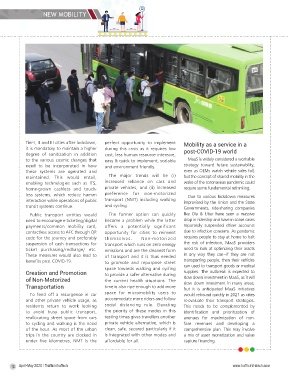
            Creation and Promotion           to provide a safer alternative during   supplies. The outbreak is expected to
            of Non-Motorized                 the  current  health  situations.  The   slow down investment in MaaS, as it will
            Transportation                   time is also ripe enough to add more   slow down investment in many areas,
                                                                              but it is anticipated MaaS initiatives
             To fend off a resurgence in car   space for micromobility users to   would rebound quickly in 2021 as cities
            and other private vehicle usage, as   accommodate more riders and follow   re-evaluate their transport strategies.
            residents return to work  looking   social distancing rule. Elevating   This needs to be complemented by
            to avoid busy public transport,   the priority of these modes in this   identification and  prioritization of
            reallocating street space from cars   testing times gives travellers another   avenues for maximization of non-
            to cycling and walking is the need   private vehicle alternative, which is   fare revenues and developing a
            of the hour. As most of the urban   clean, safe, secured particularly if it   comprehensive plan. This may involve
            trips in the country are clocked in   is integrated with other modes and   a mix of asset monetization and value
            under  five  kilometres,  NMT  is  the   affordable for all.      capture financing.


      12  April-May 2020 / TrafficInfraTech                                                       www.trafficinfratech-com-500653.hostingersite.com

