


Page 56 - TrafficInfraTech Magazine - Linking People Places & Progres
P. 56
TECHNOLOGY


                                                                                the impact of COVID-19. We felt this
                                                                                change would help us in understanding
                                                                                the travel behaviour after the impact of
                                                                                COVID-19. When we started compiling,
                                                                                the results were interesting.
                                                                                  In the current study, the peak hour is
                                                                                observed between 8:45 hrs- 9:45hrs and
                                                                                the total number of vehicles recorded
                                                                                are 20,074. Also, the peak flow of
                                                                                vehicles are observed from 8:30hrs
                                                                                onwards and the same is maintained
                                                                                till 11:00hrs. It’s quite interesting to
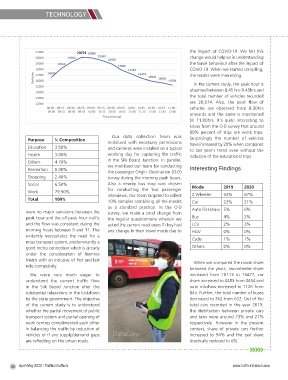
                                                                                know from the O-D survey that around
                                                                                80% percent of trips are work trips.
                                                Our data collection team was
             Purpose    % Composition                                           Surprisingly the number of vehicles
                                              mobilized with necessary permissions   have increased by 20% when compared
             Education  3.50%                 and cameras were installed on a typical   to last year’s trend even without the
             Health     3.00%                 working day for capturing the traffic   inclusion of the educational trips.
             Others     4.70%                 in the Silk Board Junction. In parallel,
                                              we mobilised our team for conducting
             Recreation  0.00%                                                  Interesting Findings
                                              the passenger Origin -Destination (O-D)
             Shopping   2.40%                 survey during the morning peak hours.
             Social     6.50%                 Also a nearby bus stop was chosen   Mode        2019     2020
             Work       79.90%                for conducting the bus passenger
                                              interviews. Our team targeted to collect   2 Wheeler  65%  67%
             Total      100%
                                              10% samples combining all the modes   Car       22%      21%
                                              as a standard practice. In the O-D
            were no major variations between the   survey, we made a small change from   Auto Rickshaw 5%  6%
            peak hour and the off-peak hour traffic   the regular questionnaire wherein we   Bus  4%   2%
            and the flow was consistent during the   asked the current road users if they had   LCV  2%  3%
            morning hours between 9 and 11. This   any change in their travel mode due to   HGV  0%    0%
            evidently necessitates the need for a
            mass transport system, predominantly a                               Cycle        1%       1%
            good metro connection which is already                               Others       0%       0%
            under the consideration of Namma
            Metro with an inclusive of first and last                             When we compared the mode share
            mile connectivity.
                                                                                between the years, two-wheeler share
             We were very much eager to                                         increased from 10113 to 13477, car
            understand the current traffic flow                                 share increased to 4283 from 3454 and
            in the Silk Board Junction after the                                auto rickshaw increased to 1126 from
            substantial relaxations in the lockdown                             845. Further, the total number of buses
            by the state government. The objective                              decreased to 362 from 632. Out of the
            of the current study is to understand                               total cars recorded in the year 2019,
            whether the partial movement of public                              the distribution between private cars
            transport system and partial opening of                             and taxis were around 73% and 27%
            work centres complimented each other                                respectively. However in the present
            in balancing the traffic by reduction of                            context, share of private cars further
            vehicles or if any supply/demand gaps   DataCorp                    increased to 94% and the taxi share
            are reflecting on the urban roads.                                  drastically reduced to 6%.


      56  April-May 2020 / TrafficInfraTech                                                       www.trafficinfratech-com-500653.hostingersite.com

